Before you redesign your website
A redesign can help, but only if the brief is based on the real enquiry problems. Use this guide to diagnose first, then build with less guesswork.
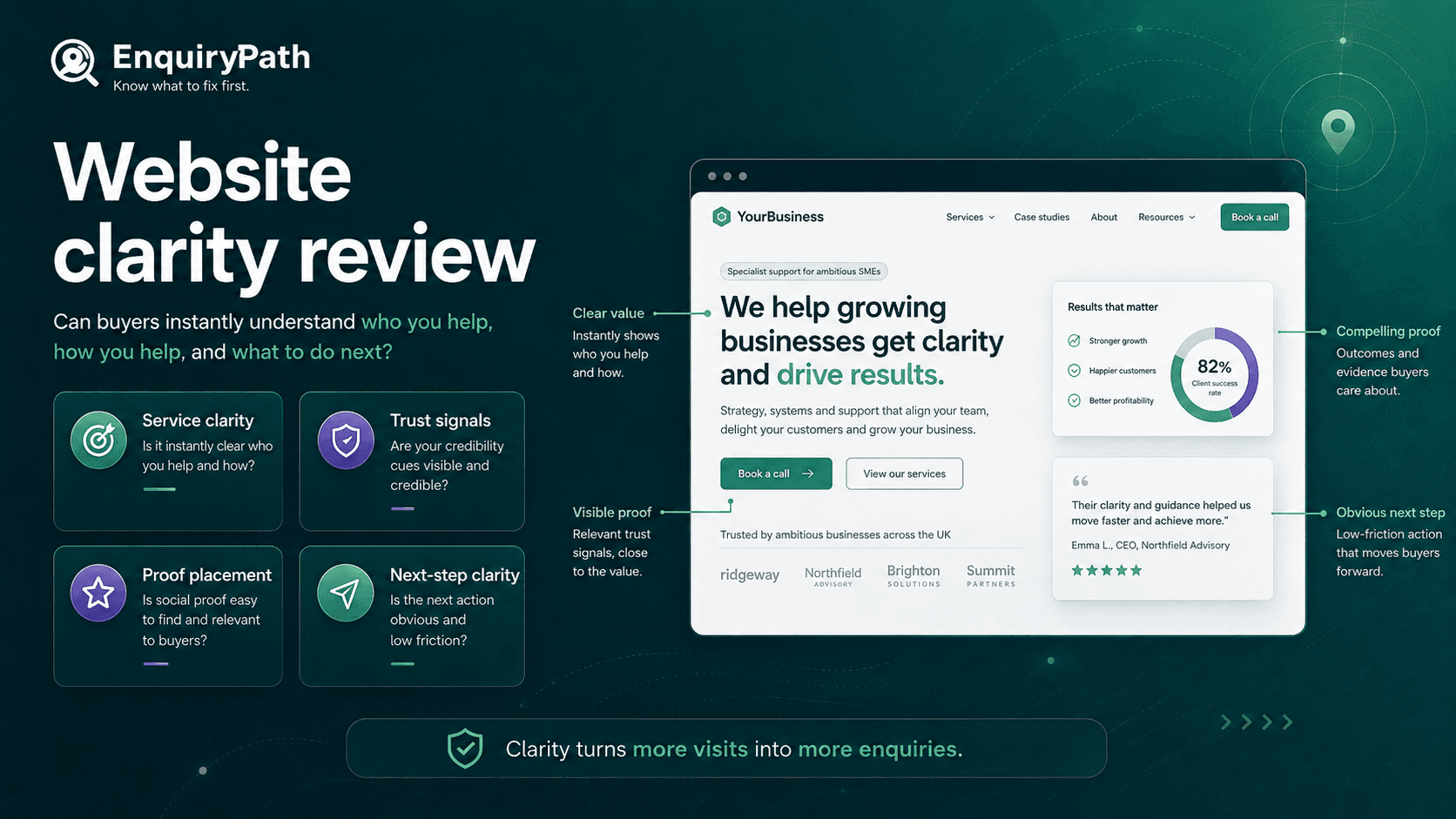
A stronger redesign brief starts with the public friction points that make buyers hesitate.
Quick self-audit
Run these checks first
- Is the current problem visual design, service clarity, proof, mobile friction or all four?
- Which pages actually shape enquiry confidence?
- What should stay because it already builds trust?
- What evidence will the designer or copywriter use to prioritise the rebuild?
Watch out for
Common enquiry leaks
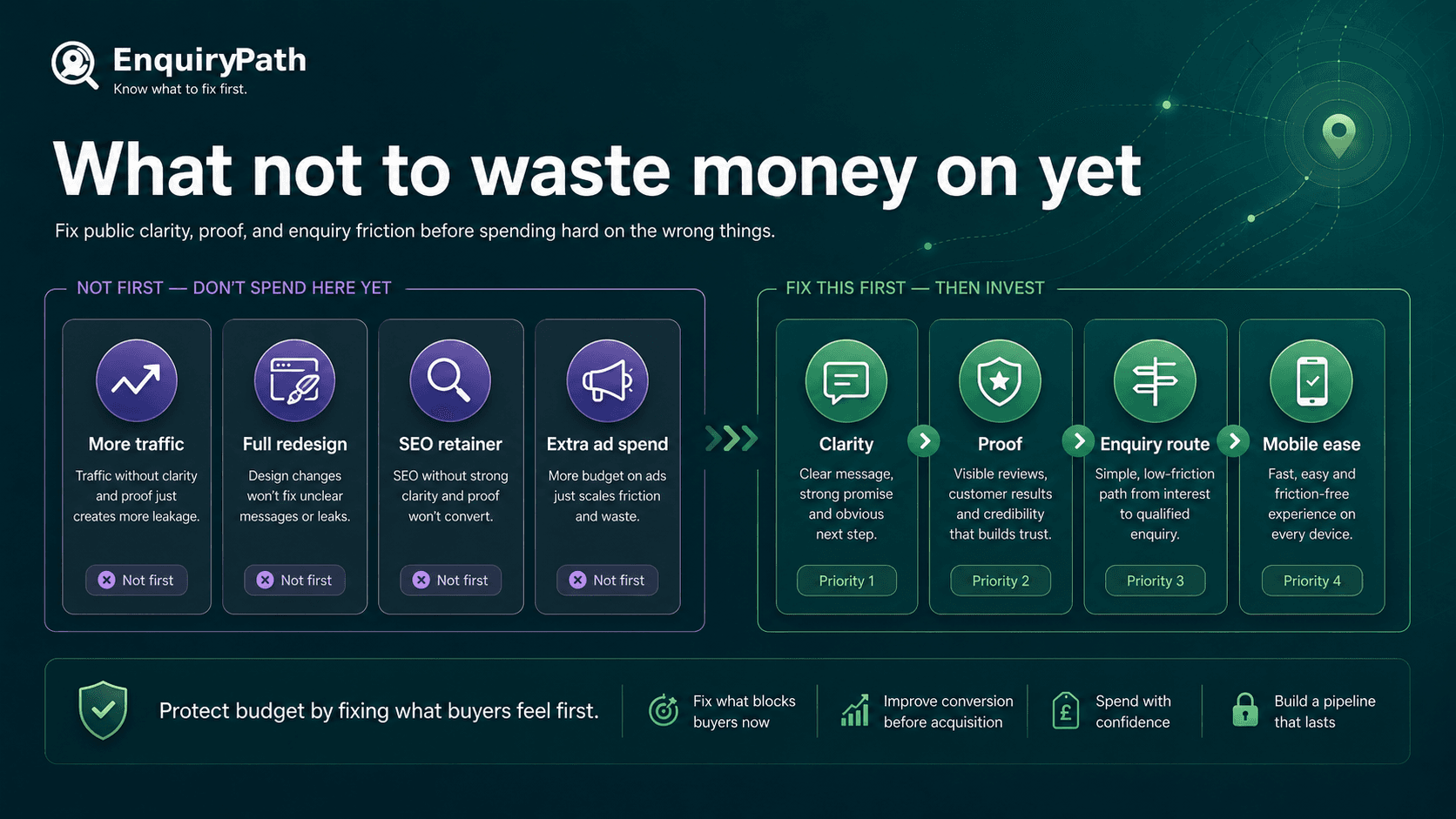
- Redesigning every page because the site feels old, without diagnosing buyer friction.
- Choosing a visual style before clarifying service hierarchy and proof.
- Replacing useful trust content with prettier but thinner copy.
- Asking a supplier for free strategy when what you need is a proper brief.
Fix-first order
What to improve first
- 1List the current enquiry problems in plain English.
- 2Map the homepage, service pages, proof and contact route.
- 3Decide what needs rewriting, restructuring or rebuilding.
- 4Give suppliers a prioritised brief instead of a vague redesign request.
Field guide
Work through the sections in order if you are diagnosing your own site. If you already know the weak spot, jump straight to the relevant section and use the checks as a practical brief.
A redesign is not a diagnosis
A new website can be useful when the current site is dated, hard to use or no longer reflects the business. But many redesign projects start with a feeling rather than a diagnosis: the site looks old, enquiries are weak, competitors look better.
Those concerns may be valid, but they are not yet a brief. A better brief explains what is making buyers hesitate and what the new site needs to make clearer.
Without that diagnosis, a redesign can make the site prettier while leaving the same public enquiry leaks in place.
Separate look, structure, copy and trust
A redesign is often treated as one job, but weak enquiries can come from several different problems. Separating them makes the project easier to scope and easier to judge.
- Look: the site feels dated, cramped or inconsistent.
- Structure: important services are buried or competing with each other.
- Copy: the page uses vague claims instead of plain buyer language.
- Trust: proof is thin, vague or too far from the decision point.
- Friction: contact routes are hidden, long or unclear on mobile.
- Fit: the page does not show who the service is for, where it applies or what happens next.
Map the pages that shape enquiry confidence
A redesign brief should focus on the public pages and profiles that shape confidence, not just the pages that are easiest to rebuild.
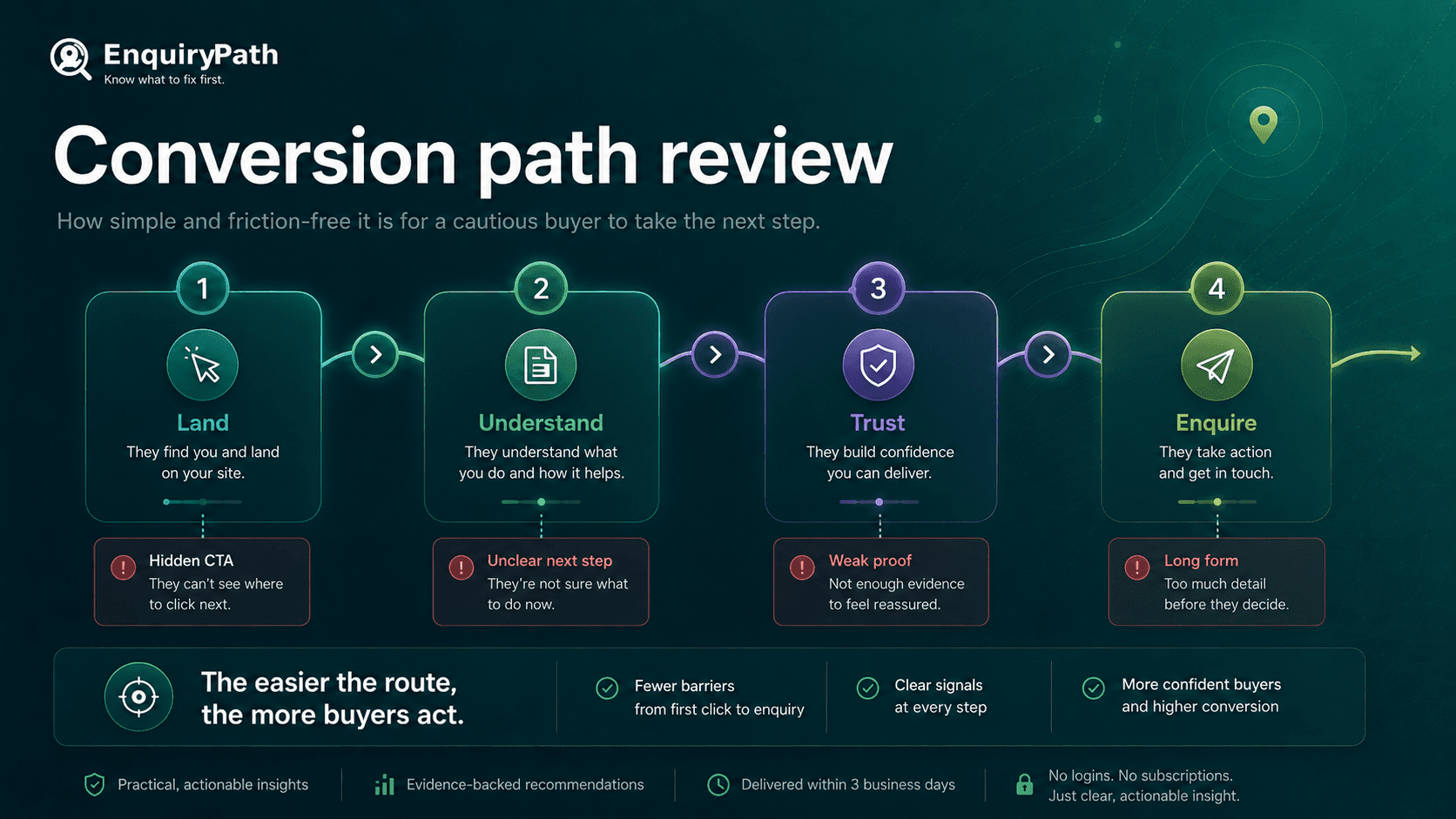
- 1Homepage: does it explain the offer, location and next step?
- 2Service pages: do they answer the buyer's doubts?
- 3Proof: are reviews, case examples or credentials close to the decision?
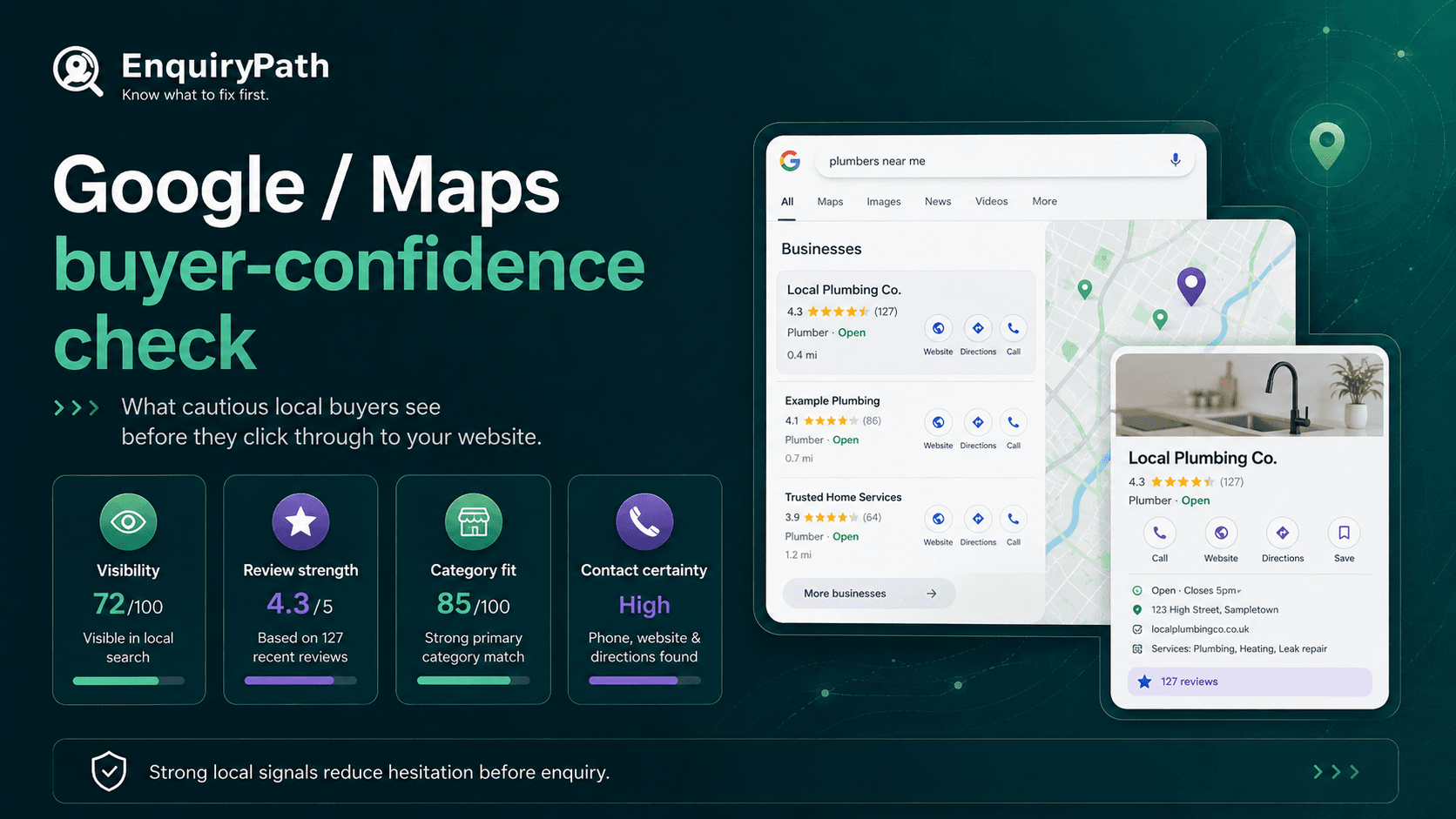
- 4Google profile: does it support what the website says?
- 5Contact route: is it obvious and low-friction on mobile?
- 6Competitor comparison: what do competing sites explain better?
Decide what to keep, change and remove
A redesign does not mean throwing everything away. Many SME websites already contain useful proof, customer language, service details or founder credibility. The job is to preserve what builds trust and remove what creates noise.
- Keep: specific reviews, useful FAQs, clear service descriptions, real photos and strong proof.
- Change: vague headlines, buried service hierarchy, weak calls to action and unclear location signals.
- Remove: filler copy, unsupported claims, duplicate pages, old services and anything that slows the decision.
- Add: proof near action points, clearer service fit, stronger mobile routes and better next-step reassurance.
Build a proper supplier brief
Web designers, copywriters and developers can do better work when the brief explains what needs fixing. Diagnosis reduces guesswork, unpaid audit conversations and scope creep.
A useful brief is not just a list of pages. It explains the buying situation, the current friction, the proof available and the decisions the new site must help visitors make.
- Business goal: what kind of enquiries should the site support?
- Buyer profile: who needs to trust the business before contacting it?
- Current friction: where do visitors likely hesitate?
- Proof assets: reviews, examples, photos, credentials, process details or customer language.
- Priority pages: homepage, key service pages, proof pages and contact route.
- Success checks: what should be easier for a visitor after launch?
Questions to ask a web supplier
- 1How will you decide the homepage hierarchy?
- 2What buyer questions should each service page answer?
- 3Where will proof appear near enquiry points?
- 4How will the mobile enquiry route be tested?
- 5What content do you need from us before design starts?
- 6How will we avoid replacing useful substance with thinner copy?
When a redesign is probably justified
- The site is hard to use on mobile.
- The business has changed and the site no longer reflects the offer.
- Key services are buried or explained badly.
- The current structure makes practical improvements difficult.
- Competitors make buyer confidence much easier.
- The brand presentation is actively reducing trust for the type of customer you want.
When smaller fixes may be enough
Not every weak enquiry problem needs a rebuild. Sometimes the first sensible move is to improve headings, proof placement, service pages, Google profile consistency and contact routes. A redesign can then happen later with a clearer brief.
- The site is technically usable but the message is unclear.
- The main issue is proof placement rather than design.
- The contact route can be improved without changing the whole site.
- The business is still testing its offer and should not lock into a large rebuild yet.
A practical pre-redesign week
Before asking for quotes, spend one week gathering evidence. This makes supplier conversations sharper and protects you from paying for a redesign that solves the wrong problem.
- 1List the top three services you want more enquiries for.
- 2Review the homepage and those service pages on mobile.
- 3Collect the best five reviews or proof points.
- 4Compare one realistic competitor.
- 5Write the five buyer questions the new site must answer.
- 6Turn that into a one-page brief before asking for proposals.